
Reclaim Your Voice Today
You deserve to be heard. Download your free guide to break free from silent treatment and reclaim your power in your relationship.
This guide explains how to effectively deal with a passive-aggressive husband by understanding the roots of his behavior, setting healthy boundaries, and reclaiming your own happiness. Whether you're a wife exhausted by silent treatments and subtle sabotage, or a partner trying to understand why direct communication feels impossible, Coach Nora provides experience-based strategies to help you navigate this challenging relationship dynamic.

How to Deal With a Passive-Aggressive Husband: Practical Strategies That Work
with a lot of patience.....and plan B always handy!
Perhaps you have been following this conversation for some time, and now you realize that we are always developing ideas about this particular situation...we have offered you solutions that cover a wide spectrum of possibilities.
Basically now, we understand this behavior as a childhood-learned defensive strategy. He has grown up under some kind of parental attitude that prevented him from expressing his anger, and thus developed this shell to cover it up. Instead of confronting, explaining his needs, and getting some agreement with other people, he decides it's not worth it and proceeds to do his own thing. Of course, being oblivious to the fact that he is pushing his now partner away!
If you try to negotiate with him, thinking that he is a grown-up man you are dealing with, sorry, but you are wrong....he is a kid (a resentful one) inside. So, let's do the refresher course on how to deal with him:
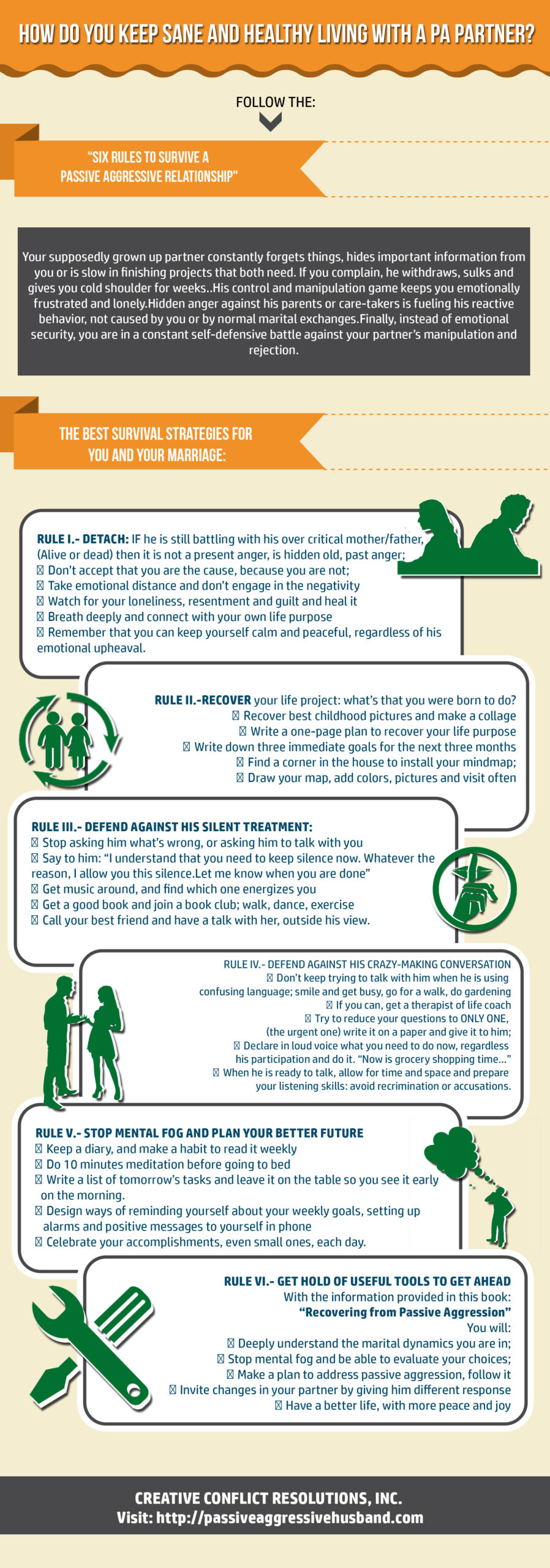
Have a Plan B: review your life, dust your basic life mission, and refresh your goals. You need to have a happy productive life, with him or without him. This will give you lots of good things to do and so take the pressure off him. You are not expecting him to be all the source of your happiness! Given that you have your own fun and interesting things to do, he will be forced to stop doing passive aggression only to get back at you for the hurt his parents did to him...
By taking the pressure off, you give him some space between your projects and his automatic response of negativity and procrastination. In this space, the question: "do I have to frustrate her always or can I have some of the same fun she has?" probably will pop into his mind...Is vital to this strategy that you show how happy and interested you are in your projects...so he can't imagine how could he destroy your joy. The purpose is to leave him alone as soon as he is doing passive-aggressive behaviors, while you continue with your own life...Here, being left alone means being left behind, and he is not as silly as to appreciate being left alone. He wants company too!
So, be clear that he will be included as soon as he can be agreeable, kind, and participative in common projects. Tell him: "as soon as you are ready to enjoy this activity, no grudges or silence or resentment included, you are in!" and be ready to slam the door.
OK, are you telling me that this is too harsh to do? well, let's go back to AskNora, read the postings there, and let me know what you want to do...Do you want to pick the role of the passive-aggressive husband victim? Or do you want to try something different?
Anyhow, if you want to refresh the basic concepts about passive aggression, here is more to read....and a good book indeed!
According to research published in the Journal of Personality and Social Psychology, passive-aggressive behavior patterns often develop as coping mechanisms during childhood when direct expression of anger was punished or discouraged, supporting the connection between early family dynamics and adult relationship challenges.
Frequently Asked Questions About Dealing With a Passive-Aggressive Husband
What are the most common signs of a passive-aggressive husband?
Common signs include the silent treatment, procrastination on agreed tasks, sarcasm disguised as humor, and denying anger while acting out resentment indirectly. These behaviors create confusion because he avoids direct confrontation while still expressing hostility through his actions.
Why does my husband act passive-aggressive instead of communicating directly?
Passive-aggressive behavior typically develops as a childhood defensive strategy when a person learned that expressing anger directly was unsafe or unacceptable. Your husband likely grew up in an environment where open emotional expression was discouraged, leading him to suppress anger and express it through indirect means instead.
Can a passive-aggressive husband change his behavior patterns?
Yes, change is possible, but it requires the passive-aggressive person to first recognize and acknowledge their behavior patterns. Professional therapy, particularly cognitive-behavioral approaches, can help him develop healthier communication skills and address the underlying childhood wounds driving the behavior.
Should I confront my passive-aggressive husband about his behavior?
Direct confrontation often backfires because passive-aggressive individuals typically deny their behavior and may escalate withdrawal tactics. Instead, focus on setting clear boundaries, communicating your needs calmly, and following through with consequences when agreements are broken.
How do I protect my emotional health while married to a passive-aggressive man?
Protecting your emotional health requires having your own Plan B—maintaining your own goals, friendships, and sources of happiness independent of your husband. This reduces the pressure on him to be your sole source of fulfillment and protects you from the emotional drain of his negative behaviors.
Is passive-aggressive behavior a form of emotional abuse?
Chronic passive-aggressive behavior can constitute emotional abuse when it consistently undermines your self-esteem, creates confusion through denial, and leaves you feeling responsible for problems you didn't create. Recognizing this pattern is essential for making informed decisions about your relationship's future.
When should I consider leaving a passive-aggressive husband?
Consider leaving when your husband refuses to acknowledge his behavior, shows no willingness to seek help, and your emotional and mental health continues to deteriorate despite your best efforts. Coach Nora emphasizes that you deserve a happy, productive life—with or without him.
📅 Last updated:


Thank you very much for this. Very helpful, indeed! I have found, over the years, trying to convince him to do family activities, or trips ends up making all of us miserable; he usually found a way to make the trip as unenjoyable as possible, if he went, when he didn’t want to. I’m focusing on making plans, without this crazy dynamic, and if he doesn’t want to go, he doesn’t have to; I’ll have fun on my own. I know it will cause so much less stress in the long run, and the trip won’t be ruined. I have waited for him to be cooperative for years, and I’m done. I want and need and deserve to have a good life, and am going to do the things that make me fulfilled